
15×15 vs. 16×20 Heat Press: Which Size Should You Buy?
A practical shop-floor guide to choosing between a 15×15 and 16×20 heat press, including workspace, DTF, hoodies, large graphics, and production workflow.
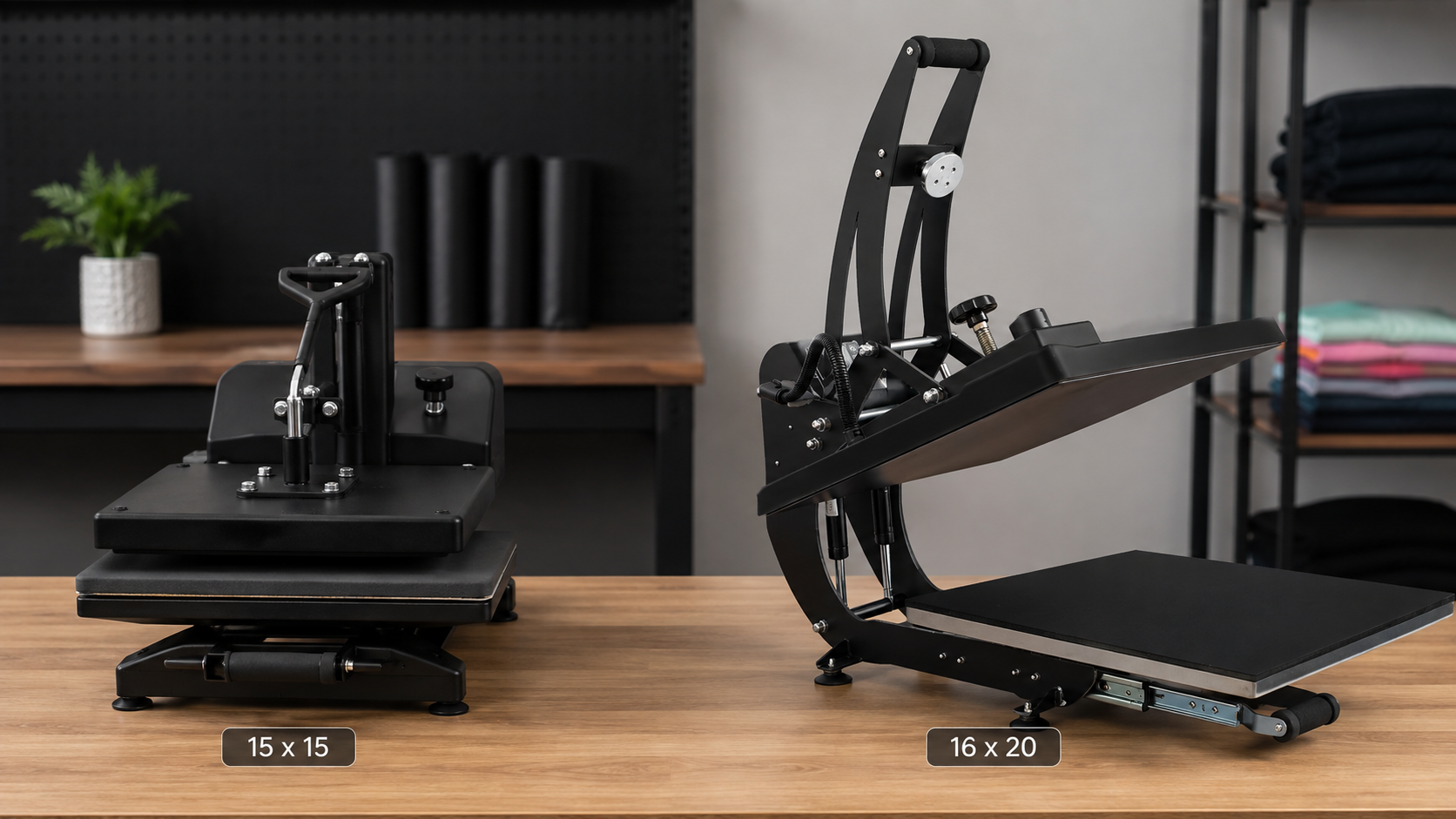
One of the first decisions people make when buying a heat press is platen size. A 15 × 15 press is common because it is compact and can handle a lot of everyday shirt work. A 16 × 20 press gives you more working area and more flexibility when designs, garments, or production demands get larger.
After more than 12 years working in apparel production and using different heat presses in a real print shop, our answer is simple: the better size depends on what you actually plan to press.
What can you do with a 15 × 15 heat press?
A 15 × 15 platen gives you 225 square inches of pressing area. That is enough for many standard left-chest graphics, youth designs, medium front prints, tote bags, and smaller transfer work.
For a hobby setup, a smaller workspace, or a business that mainly produces compact graphics, 15 × 15 can be completely practical. It also takes up less room on a table and is usually easier to fit into a home-based production area.
Why do production shops often prefer 16 × 20?
A 16 × 20 platen gives you 320 square inches of pressing area. The difference does not sound enormous until you start loading adult shirts, large back graphics, hoodies, or oversized DTF transfers all day.
The extra room gives the operator more freedom to position the garment and keep the entire design comfortably inside the heated area. That can matter when a job needs consistent heat and pressure across a larger transfer.
A larger platen is not only about printing a larger graphic. It also gives you more room to load, position, and work around garments without feeling like every job is at the edge of the platen.
Does a bigger platen automatically mean a better press?
No. Platen size is only one part of the equation. A large press with inconsistent heat or uneven pressure can still produce frustrating results. We would rather use a well-built press with dependable heat and pressure than choose equipment based on size alone.
When evaluating a heat press, also look at heat consistency, pressure control, loading access, controls, construction, serviceability, replacement parts, warranty, and how the press fits your actual workflow.
What about hoodies and oversized prints?
This is where the additional area of a 16 × 20 press becomes easier to appreciate. Hoodies are bulky, seams can affect loading, and large back graphics need room. A larger platen gives you more flexibility to position those jobs without crowding the transfer area.
That does not mean every hoodie requires a 16 × 20 press. It means the larger platen gives you more margin when jobs become less predictable.
Which size is better for DTF transfers?
Both sizes can apply DTF transfers when the artwork fits comfortably within the platen and you follow the transfer manufacturer’s time, temperature, pressure, and peel instructions. For shops regularly producing full-size adult graphics or larger transfers, the extra area of a 16 × 20 press can make production easier.
Which size would we choose for a production shop?
If we were choosing one primary flat heat press for a working apparel shop, we would generally choose 16 × 20. It gives you enough room for everyday work while leaving more flexibility for larger graphics and garments.
That is also why the Alien Press AP1 and Alien Press AP2 use a 16 × 20 platen. We designed the lineup around the type of production work we deal with ourselves.
When does 15 × 15 make more sense?
Choose the smaller footprint when workspace is tight, your designs are consistently smaller, portability matters, or you simply do not need the additional pressing area. Buying equipment for work you will never perform does not make a shop more efficient.
The bottom line
A 15 × 15 heat press can be a capable choice for smaller designs and limited spaces. A 16 × 20 press gives a production shop more room to grow, more freedom when loading garments, and more flexibility for larger transfers.
The question is not which number looks better on a specification sheet. The question is which platen gives you enough working area for the jobs you actually want to produce.
Still deciding? Read our Heat Press Buying FAQ, explore the Alien Press lineup, or make contact and tell us what you plan to press.