
Welcome to Field Notes: Real Heat Press Knowledge From the Shop Floor
Welcome to Alien Press Field Notes. This is where we share practical heat press knowledge, DTF tips, production advice and real lessons learned from working on the shop floor.
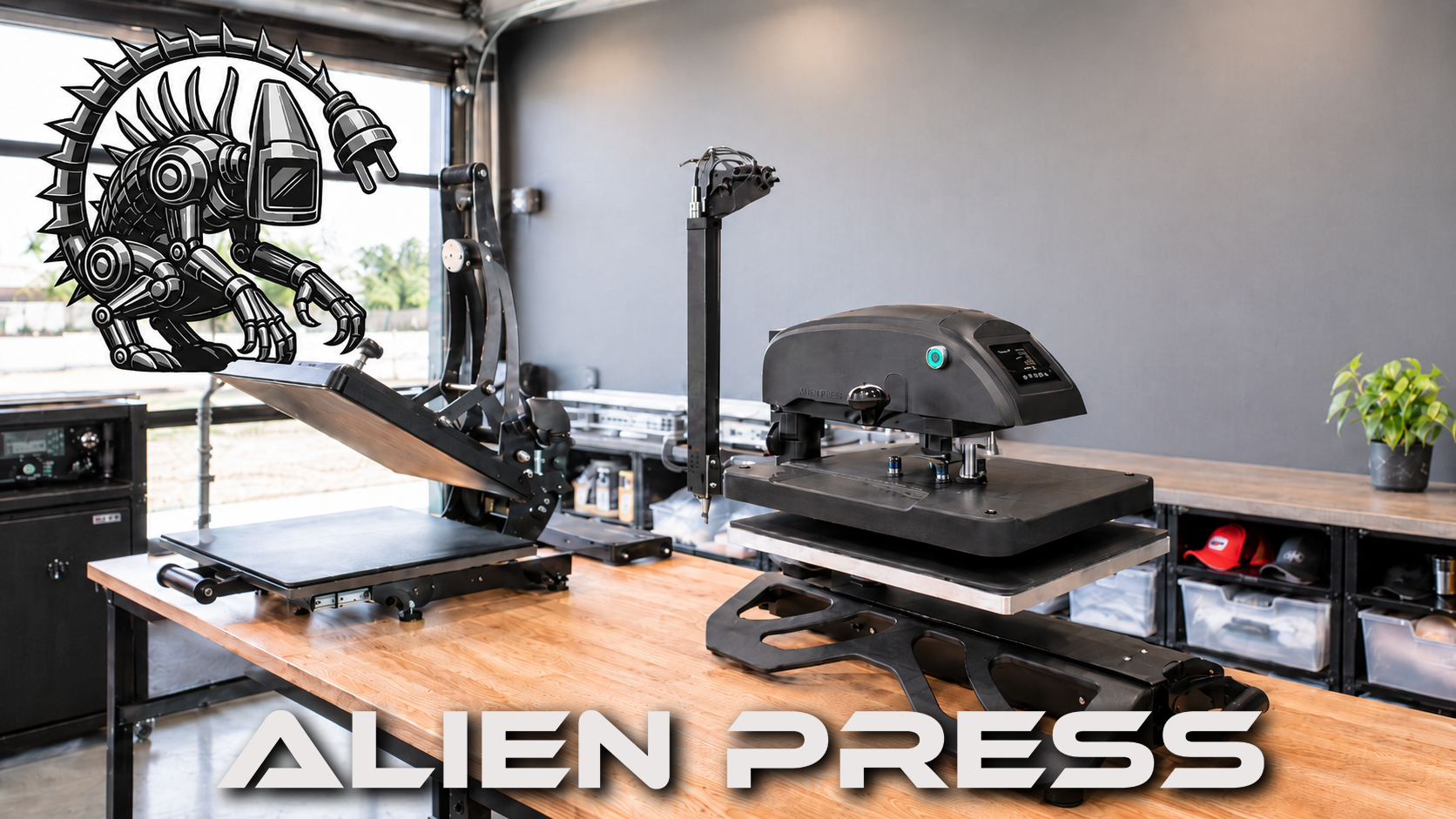
Every mission needs a starting point. This is ours.
Field Notes is where Alien Press will share what we have learned from years of working with heat presses, transfers, DTF production, and apparel printing in a real shop environment.
There is no shortage of heat press advice online.
Some of it is helpful. Some of it is copied from manufacturer manuals. Some of it comes from people who have never actually had to finish a production run with a deadline staring them down.
Field Notes is going to be different.
Alien Press was built from years of working inside the apparel printing industry, using heat presses every day, producing real customer orders, solving real production problems, and learning what matters once equipment moves beyond the showroom and onto the shop floor.
That is exactly where Field Notes starts.
What Field Notes Is
Field Notes is the educational side of Alien Press.
This is where we will talk about heat presses, transfers, DTF printing, production workflow, pressure, temperature, platen sizes, troubleshooting, equipment decisions, and the small details that can make a big difference when you are actually trying to get work out the door.
We are not interested in publishing articles just to fill a blog.
Every Field Note should answer a real question, solve a real problem, or help a printer make a better decision.
Sometimes that means comparing two heat press sizes.
Sometimes it means explaining why a transfer is not adhering correctly.
Sometimes it means talking about pressure, cold spots, platen alignment, or what actually separates a production-ready heat press from a machine that looks good on a product page.
Make the information useful enough that we would want it ourselves.
Built Around Real Production Experience
Alien Press did not begin as a marketing idea.
It came from years of working with heat presses in a real print shop.
Over that time, we have used different machines, different transfer systems, different platen configurations, and different production setups. We have seen presses that performed extremely well and others that created unnecessary problems.
You learn quickly that specifications only tell part of the story.
A heat press can look impressive on paper and still be frustrating to use during a busy production day.
Controls matter. Platen access matters. Pressure consistency matters. Recovery time matters. The way a machine fits into an actual workflow matters.
Those are the kinds of things we want to talk about here.
What We Will Cover
Field Notes will focus heavily on the questions printers actually ask.
You can expect articles covering topics such as choosing the right heat press size, 15×15 vs. 16×20 heat presses, automatic vs. manual heat presses, DTF pressing temperature and pressure, transfer adhesion problems, heat press cold spots, platen selection, pressing hoodies and thicker garments, production workflow, heat press maintenance, commercial vs. entry-level equipment, and when accessories and specialty platens make sense.
We will also cover lessons we learn while using Alien Press equipment in production.
If we discover something that makes pressing easier, faster, cleaner, or more consistent, it belongs here.
We Are Not Going to Pretend There Is One Answer for Everyone
One of the biggest problems with equipment advice is that it is often presented as if every print shop works the same way.
They do not.
A person pressing a few shirts each week has different needs than a shop producing hundreds of garments a day.
A DTF operation may prioritize different features than someone working primarily with HTV or screen print transfers.
A shop with limited space may make a different decision than a production floor with several dedicated presses.
That is why our Field Notes will focus on explaining why something works, not just telling you what to buy.
The right answer depends on what you are producing, how much you are producing, and how you work.
We Will Keep It Practical
You will probably notice that Field Notes does not read like a textbook.
That is intentional.
We want these articles to feel like a conversation between printers.
We will explain the technical side when it matters, but we are not going to bury useful information under unnecessary terminology.
If there is a simpler way to explain something, we will use it. If a photo explains it better, we will show it. If the answer depends on the garment, transfer, or equipment, we will say that too.
And if we do not know something, we are not going to make up an answer just to sound authoritative.
The Equipment Will Be Part of the Conversation, Not the Entire Conversation
Yes, Alien Press builds heat presses.
Naturally, we will talk about our equipment.
But Field Notes is not meant to become a long series of advertisements.
There is much more value in helping someone understand how heat pressing works than repeatedly telling them to buy a machine.
When an Alien Press product makes sense in the discussion, we will show you why.
When the article is simply about better pressing technique, that is what we will focus on.
That distinction matters.
Tested on Earth
One idea sits at the center of Alien Press:
Use the equipment. Learn from it. Improve it.
We run Alien Press machines in a working print environment because that is where you discover what really matters.
Field Notes follows the same philosophy.
We are going to take what we learn from production and put it here.
That includes the good, the frustrating, the technical, and the things most equipment websites never talk about.
Welcome to Field Notes
If you own a print shop, are starting an apparel business, work with DTF transfers, or simply want to understand heat pressing better, Field Notes is for you.
There is a lot we want to cover.
Some articles will be detailed buying guides. Others will be quick production lessons. Some will come directly from something we ran into that week on the shop floor.
But they will all have one thing in common:
Real heat press knowledge from people who actually use heat presses.
Welcome aboard.
This is Field Notes.